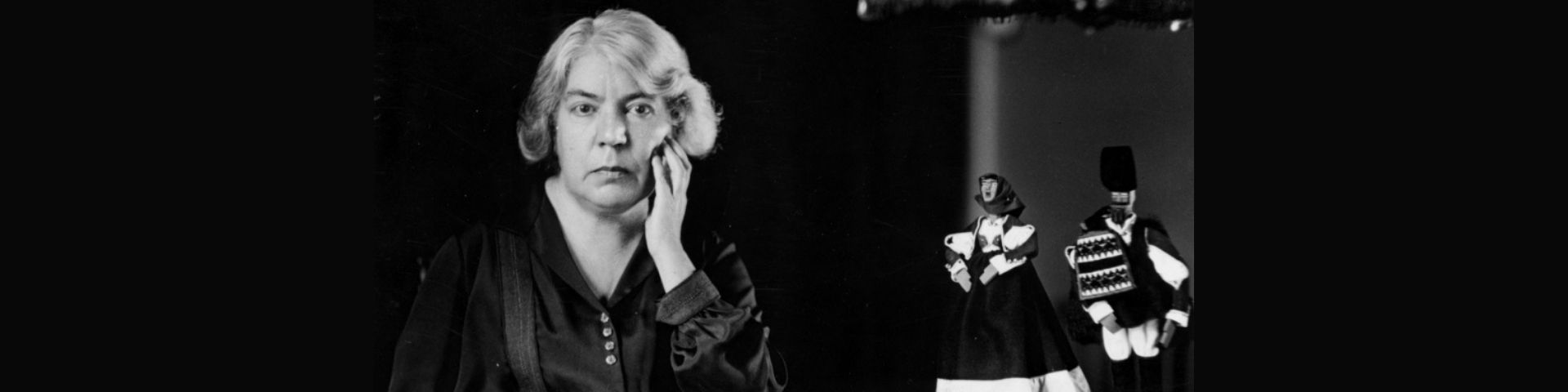
With a hint of ill-concealed resentment, Matilde Serao – the last female writer I wrote about some time ago – declared that, when in 1926 she was competing with Grazia Deledda for the Nobel Prize for Literature, Mussolini personally intervened against her candidacy, since the journalist had never hidden her aversion to fascism. Thus it was that on 10 November 1927 (but the recognition referred to the previous year, which had no winners) Grazia Deledda was awarded the prestigious prize: the only woman of the six Italian writers to boast the high honor to date.
Not that Grazia Deledda ever let herself be enchanted or seduced by fascism, but certainly, in the cultural and social panorama of the time, she was a more shy and much more introverted figure than Serao and was considered a less hostile and less fearsome voice. An extremely simplistic and incorrect assessment, because if there was ever an indomitable and revolutionary writer, it was Grazia Deledda.
Let’s get to know her through the opening words of her speech in Stockholm:
I was born in Sardinia. My family, made up of wise people but also violent people and primitive artists, had authority and also had a library. But when I started writing, at thirteen, I was annoyed by my parents. The philosopher warns: if your son writes verses, correct him and send him on the road to the mountains; if you find it in the poem the second time, punish it again; if he goes for the third time, leave him alone because he is a poet. Without vanity, this happened to me too.
So much strength in this lightning-fast autobiography! He never raised his voice, Grazia; he never made any noise and his pages are watercolors with soft colours, whispering just like the Sardinian wind that makes his very tall reeds dance in sinuous waves. Yet, without making any noise, he reached the pinnacle of literature.
A land, Sardinia, that I have only begun to get to know in recent times, enjoying the opportunity, thanks to my sister’s work, to always visit it outside the season of crowded beaches. I remember the first walk near the ponds of Cagliari: we walked slowly and reeds with golden feathers bowed as we passed, a solitary one or many in concordant tufts: epiphany of a literary memory deposited in the depths of the heart. Canne al vento: soft and strong, mobile and tenacious, modest and proud like the women in the novel, like the inhabitants of this island, still so isolated. Over the years, from the south, stage after stage, I have slowly ascended towards the north, along that single Carlo Felice artery, which does not pretend to become a motorway and forces a slow pace, like the rhythm of life that flows away from the continent.
Here I am in Nuoro, with the accent on the u, not easy to pronounce. Nùoro: Athens of Sardinia, they tell me. And I immediately feel in tune with the city which, indeed, small as it is, was a hotbed of talents of the soul, such as the sculptor Francesco Ciusa and the great jurist Salvatore Satta.
Here is the writer’s birthplace, today a cultured and rich museum, beautiful and intense with that whispered beauty and intensity like hers and her books were. To welcome me, perched on the courtyard door, a majestic wisteria; I think of mine, which I left just in bloom in Milan: I planted it on the balcony last year, I gave it the largest pot that the space allowed, I take care of it with all of myself… but it really seems like the poor little brother of this Sardinian: although beautiful and generous, our plants certainly cannot compete in power of colour, scent, turgidity with those of the island.
In this house, Grazia, born in 1871, lived until 1899: the fourth of seven children, she received an excellent education, not so much at school but, from the fifth grade onwards, at home, followed privately by a teacher of great culture and humanity; he continued his studies as a self-taught person, developing a deep love for classical literature, which he embodied in his first youthful writings. But the family and the Nuoro society were certainly not ready to throw open the window and let this sincere and profound poetic aspiration fill the rooms of the house and the streets of the city. Fighting an unequal battle, Grazia, already at the age of sixteen, sent her first stories – Sangue sardo e Remigia Helder – in Rome, where they were appreciated and published in a successful magazine, The latest fashionwho immediately afterwards published his first novel, Fernanda’s Memoirspublishing it in installments. In essence, the novel presents the themes that will always be dear to the writer: the teenager Fernanda listens to the stories of a dying old man, in which different characters are protagonists of loves, passions, scandals and intrigues: the drive to escape and adventure of a girl who is little more than a teenager is evident…
Il secondo romanzo, Anime onestewelcomed by the severe literary censors in vogue at the time, he masterfully paints both the island landscape and the portraits of the protagonists of a human drama made up of wrong loves and feelings, of melancholy and jealousy, secrets, repressed desires: it is his Sardinia, it is his life, eager to escape. Cosima, quasi Grazia it is the autobiographical, yet fictionalized work that tells so much about the writer’s interiority. Unfinished and released posthumously in 1937, the story accompanies an intelligent and curious little girl, who moves through the rooms that I wander through enraptured, immersing myself in a world that, if it no longer exists in Sardinia, certainly cannot have existed. in continente. The kitchen, the pantry, Grazia’s room, were arranged thanks to the pages of this and other books:
And the kitchen was, as in all still patriarchal homes, the most inhabited, warmest environment of life and intimacy. There was the fireplace, but also a central hearth, marked by four stone slats: and above, at eye level, attached with four fur ropes to the large beams of the ceiling made of reeds blackened by the smoke, a trellis of about a square meter, on which there were almost always, exposed to the smoke which hardened them, small wheels of pecorino cheese, the smell of which spread all around.
You can still smell the scent of that pecorino if you inhale by closing your eyes…
In 1899, Grazia, who by now collaborated with Sardinian, Roman and also Milanese magazines, moved to Cagliari, where she met Palmiro Madesani, an official of the Ministry of Finance, and married him after a very short time.
The two move to the province of Mantua, the husband’s birthplace, and then definitively to Rome, where the man, a more unique than rare case in the history of humanity, even decides to leave his job to support his wife, becoming her literary agent: wonderful! With their two children, the couple has since lived a quiet and reserved life in the Roman house, where Grazia has a room of one’s ownfaithfully reconstructed in the basement of the Nuoro museum, where the cellars originally stood: parquet flooring, wallpaper, chandelier adorned with tassels, velvet curtain.
In quello studio nascono i grandi romanzi della Deledda: Elias Portolu in 1903, Cenere in 1904, L’edera in 1908 and then, in an ascending climax, But to the edge, Colombi e sparvieriuntil the masterpiece Canne al vento of 1913, which earned her her first nomination for the Nobel Prize for Literature.
Admired by many, she was particularly, and not surprisingly, appreciated by Verga, also an islander, who shared with her not only the love for his own land, but the extraordinary ability to make an isolated and secluded land (although Sicily and Sardinia differ incredibly!) into a universal place, where time and space go beyond the sea and the calendar and bring messages full of modernity and current affairs. The more rooted in Sardinian culture and tradition, the more Grazia Deledda’s novels are harbingers of a universal humanity, whose soul is explored and told with an acuity and sensitivity that makes them close to all of us. A profound connoisseur and lover of Russian literature, Deledda maintained an epistolary relationship with the family of Dostoevsky, whom she defined as the greatest modern artist.
I cannot fail to mention Grazia’s social commitment and, above all, her candidacy for the Italian Parliament, the first woman in history: in March 1909, when women were still far from having the right to vote, in the lists for the elections to the twenty-third Legislature of the Kingdom of Italy, the writer’s name appeared in the lists of the Italian Radical Party, in the Nuoro constituency of the Chamber: clearly the time was not ripe for her to make a statement (of the 34 votes she obtained, 31 were contested), but this was certainly an important step on the path of women’s suffrage and the role of women in politics. How much courage in a woman who never needed to raise her voice or appear!
Following in the footsteps of dear President Mattarella, who recently visited Nuoro on the centenary of the great Nobel Prize, we too celebrate Grazia Deledda, promising her that we will never, in a little boat, displease and never send a little girl on the road to the mountains who we catch intent on writing verses…
PakarPBN
A Private Blog Network (PBN) is a collection of websites that are controlled by a single individual or organization and used primarily to build backlinks to a “money site” in order to influence its ranking in search engines such as Google. The core idea behind a PBN is based on the importance of backlinks in Google’s ranking algorithm. Since Google views backlinks as signals of authority and trust, some website owners attempt to artificially create these signals through a controlled network of sites.
In a typical PBN setup, the owner acquires expired or aged domains that already have existing authority, backlinks, and history. These domains are rebuilt with new content and hosted separately, often using different IP addresses, hosting providers, themes, and ownership details to make them appear unrelated. Within the content published on these sites, links are strategically placed that point to the main website the owner wants to rank higher. By doing this, the owner attempts to pass link equity (also known as “link juice”) from the PBN sites to the target website.
The purpose of a PBN is to give the impression that the target website is naturally earning links from multiple independent sources. If done effectively, this can temporarily improve keyword rankings, increase organic visibility, and drive more traffic from search results.