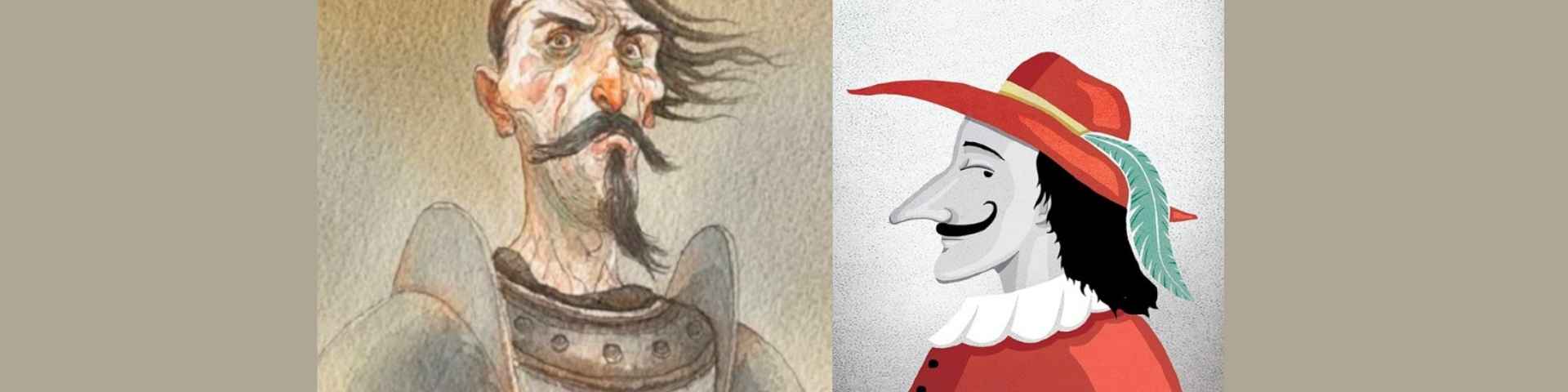
Cyrano’s voice is silent forever and his death with the sword in his hand and the last ones on his lips suggests a first reflection together with the boys: is the Gascon a loser or a winner? Is he weak or is he strong? Alan splits the hero’s two personalities, saying that he is strong as a swordsman but weak in that love that he is unable to declare until the end; on the other hand, he continues, if we compare him to Don Quixote, the object of endless beatings, Rostand’s hero is always unconquered, except by his last enemy, death. The confrontation between the two heroes occupies the field from this moment: Cyrano really seems to us to be one of the many “sons of Don Quixote”. Matilde, with her usual sensitivity, gets to the heart of the matter: they both live in fiction, but, while Don Quixote truly believes in what he does, Cyrano is fully aware of it. Elisa, in fact, says that the hidalgo is strong in love – unlike the Gascon – because he praises and defends the woman he loves even though she never appears. Gabriel underlines the strength of Cyrano, who moves forward despite his physical defect and Matilde understands that, while he knows how to use his insecurities to become stronger, Cervantes’ protagonist moves forward because he is not insecure. Don Quixote dies denying his fiction, Cyrano confirming it to the end, until his death. It almost seems that Cyrano shifts the discussion from the theme of fiction to the theme of authenticity, in the name of which he lives every moment: the falseness of opportunism is the great enemy. When comparing the two it is impossible not to notice the difference between their friends: Sancho on one side, Cristiano on the other. The former is inferior to his master, apparently in everything; Cristiano, on the other hand, dominates due to his physical appearance.
But this is precisely what makes us ask: what relationship is there between beauty and greatness of soul? After all, the former is very often equated with a sort of existential superficiality. Matilde suggests considering that those who are beautiful, most of the time, never have to develop other skills, because they are the center of attention; his personality, after all, becomes secondary. Lorenzo thinks that often a person has only one great quality, all the others ultimately take second place. Beauty, like wealth, are two clothes that, skillfully worn, open many doors without there being much need to gain access.
What is certain is that Cyrano seems to make his limitation (the enormous nose, the physical ugliness) a strength: not so much because he makes it disappear, but because he interprets it, finds a way to inhabit it, just as happens in the verses in which alone, with sharp poetics, he mocks his own appearance. In this self-irony he is truly great and helps us think about what it means that every statement can always be said altrimenti. What is the virtue of knowing how to state the obvious in different and differently researched ways, why is it important for children to have a rich vocabulary? Gabriel hits the nail on the head: finding different ways to express something is the only way we have to think about it, to reflect on it, to understand. Isabel talks about heaviness and lightness, while Emma claims that the multiplicity of words always overcomes boredom. For Federica the key is similarity, which allows you to see things with a different look, that look obliquo that we always look for together with the kids. Lorenzo thinks back to the teachers, to the fact that to explain something they have to find many different ways to say it: it is a skill that the kids recognize and appreciate.
Of course it is a little scary that the word is so close, in Rostand’s work, to the sword: obviously we all know that this is the case and we also know how painful it is, sometimes, to be hit by words. Adham, however, subtly notes that there are iron swords and wooden swords, words that kill and words that provoke the challenge of thought.
Thinking of Cyrano, of his strength in stubbornly opposing life and its cruelties, we read to the children a well-known passage by the philosopher Pascal, according to which: «Man is just a reed, the weakest in nature; but it’s a thinking rod. It is not necessary for the entire universe to arm itself to crush it: a vapor or a drop of water is enough to kill it. But even if the universe crushed him, man would still be more noble than what kills him, because he knows that he is dying.” In Pascal’s famous thought, the absolute pride with which Cyrano finally stands before death, displaying his plume, seems to return. Of course, this courage often makes us alone and makes the kids reflect on this danger which, for Cyrano, is his daily bread: “displeasure is my pleasure”, he likes to say. Samuele remembers the loneliness of those who tried to really change things, like Giovanni Falcone and Paolo Borsellino. Matilde and Morgana are less idealistic and believe that a way to make themselves understood is necessary, precisely to make others better too and associate them with their own courage. We reassure you: ideal or ideological isolation is not always an advantage, it can also become a great alibi or a sort of affectation to show off.
Of course, the figure of the hero of Gascony is unforgettable for this very reason: like Don Quixote he is not an exclusively positive hero, he hides a fragility which is precisely what makes him human.
Berita Terkini
Berita Terbaru
Daftar Terbaru
News
Jasa Impor China
Berita Terbaru
Flash News
RuangJP
Pemilu
Berita Terkini
Prediksi Bola
Technology
Otomotif
Berita Terbaru
Teknologi
Berita terkini
Berita Pemilu
Berita Teknologi
Hiburan
master Slote
Berita Terkini
Pendidikan
Resep
Jasa Backlink
Slot gacor terpercaya
Anime Batch